
Dejan Galič, MD, FEBU, FECSM
urology specialist
He deals with general urology, especially urological oncology and prostate problems, as well as sexual medicine.


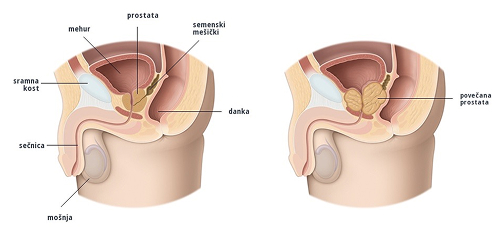
Benign prostatic hyperplasia (BPH) is a histological process in which the number of stromal, smooth muscle and epithelial cells increases, mainly in the transition and periurethral zones of the prostate. In the clinical context we speak of benign prostatic enlargement (BPE), which can narrow the prostatic part of the urethra, obstruct the outflow of urine from the bladder and cause lower urinary tract symptoms (LUTS). However, the size of the prostate alone does not tell how severe the symptoms will be. A man with a large prostate may have few or no symptoms, while a man with a smaller prostate may have significant problems.
By far the most important factor in the growth of prostate tissue is age. With increasing age, the interactions between stromal and epithelial cells, growth factors and the hormonal environment of the prostate change (higher levels of the testosterone metabolite DHT). Signs of benign prostatic hyperplasia mainly start to appear after the age of 40, and their frequency gradually increases with age.
A weaker stream, difficulty starting urination, an interrupted stream, more frequent urination, urinating at night, a sudden urge to urinate and a feeling that the bladder has not emptied completely are the most common symptoms of benign prostatic enlargement. An enlarged prostate can gradually narrow the urethra and make it harder to pass urine. Symptoms usually develop slowly and may worsen over time. In some men they are mild, while in others they significantly affect daily life and sleep. Symptoms are not always caused by the size of the prostate. Bladder function can also change with age, so similar problems can be caused by an overactive or weakened bladder.
If symptoms become bothersome or affect sleep or daily activities, a urological examination is recommended.
During the urological examination we assess the symptoms, the condition of the prostate, bladder function and any residual urine, and rule out other causes. The basic evaluation includes:
After the diagnostic work-up, the urologist decides on the most appropriate approach together with the patient, based on the severity of symptoms, the size of the prostate, the impact on quality of life, residual urine and any complications. With mild symptoms, treatment is often not needed straight away: the condition is monitored and the patient is advised to adjust daily habits, such as fluid intake, limiting caffeine and alcohol and treating constipation. For bothersome symptoms, first-line treatment is medication (α1-blockers, 5α-reductase inhibitors), combined if necessary. If medication is not enough or complications occur, we use surgical treatment, either minimally invasive procedures (TURP, ThuLEP) or open prostatectomy.
Surgery is needed for recurrent urinary retention, inability to urinate spontaneously, recurrent infections, bladder stones, recurrent macroscopic haematuria due to BPH or damage to the upper urinary tract (hydronephrosis), and when medication is not effective enough.
Author: asst. Simon Hawlina, MD, FEBU, urologist specialist


Monday - Thursday
Friday
Saturday - Sunday
08:00 - 19:00
08:00 - 16:00
Closed
Copyright © 2025 MD medicina | All Rights Reserved | Quality and safety | Privacy Policy
 English
 Slovenian
 German
 Italian
 Albanian